Aramatelqo, c. 568-555 BC. Owner was possibly Aramatelqo himself, or one of his courtiers. (Brooklyn Museum). The cartouche name: "Ara-Maa-ti-L-k/q", composed of the hieroglyphs: Horus, sickle, pestle, lion, hill.
Brooklyn Museum
public domain

Aramatelqo, c. 568-555 BC. Owner was possibly Aramatelqo himself, or one of his courtiers. (Brooklyn Museum). The cartouche name: "Ara-Maa-ti-L-k/q", composed of the hieroglyphs: Horus, sickle, pestle, lion, hill.
Brooklyn Museum
public domain
The Antelope Painter. Wine Vessel with Spotted Antelope, 2nd-3rd century C.E. Clay, slip, 10 13/16 x 16 3/4 in. (27.5 x 42.5 cm)
Brooklyn Museum
public domain

Granite head of a king (Dynasty 12 or Middle Kingdom) on display at the Iris & B. Gerald Cantor Center for Visual Arts on the Stanford University campus in Stanford, California.
public domain

Limestone head from a sarcophagus (Ptolemaic Dynasty or Greco-Roman Period) on display at the Iris & B. Gerald Cantor Center for Visual Arts on the Stanford University campus in Stanford, California.
public domain


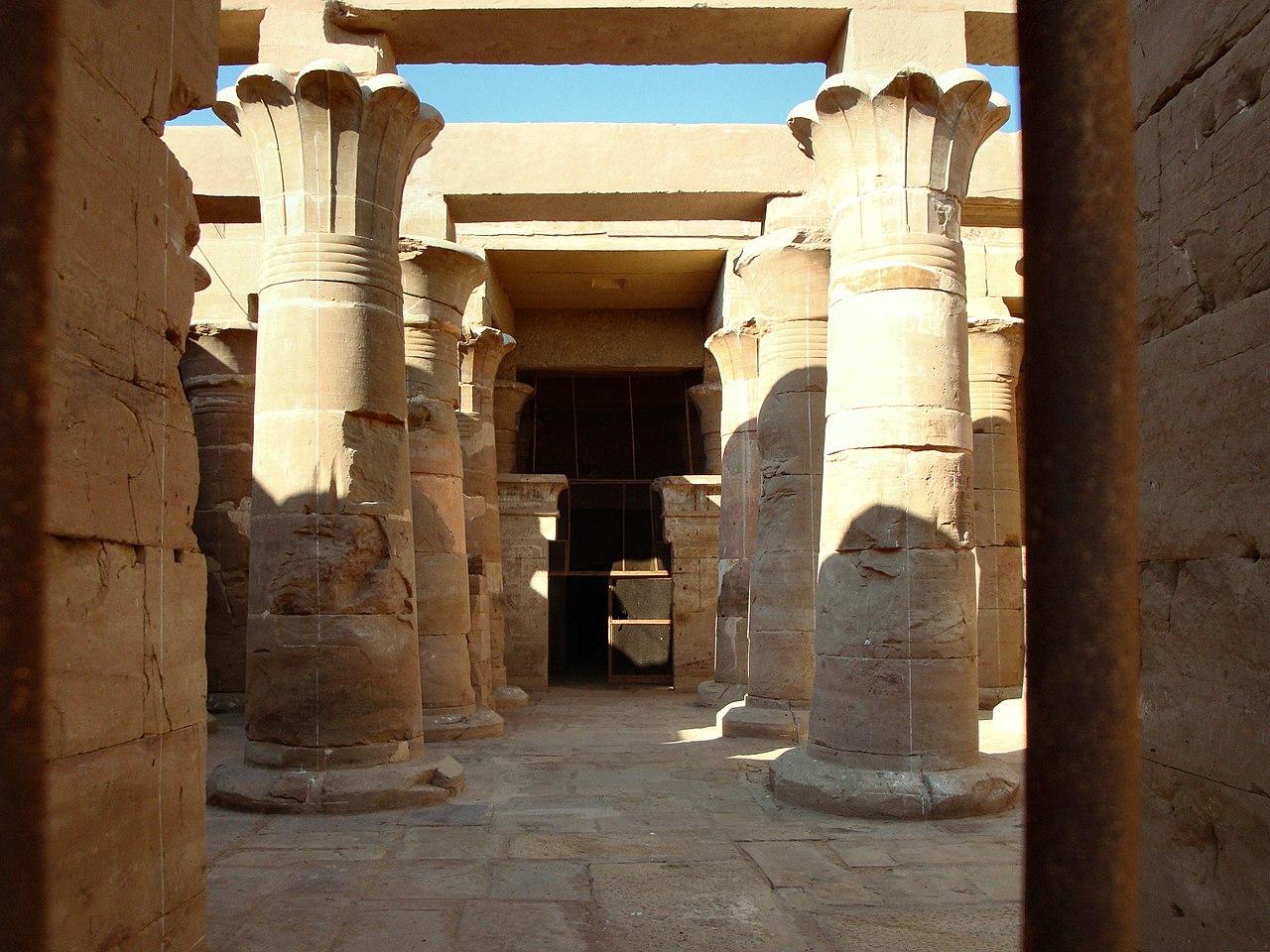

The Temple of Hibis was first founded by pharaoh Psamtik II (595-589 BC) of the 26th Saite dynasty of Egypt. It is perhaps the best preserved temple from the Late Period of Egypt and is uniquely situated at Kharga Oasis in Western Egypt. The temple was decorated by the Persian conqueror Darius I. Subsequent additions to the size of the temple were later made by the 30th dynasty kings Nectanebo I and II.
