lunes, 31 de mayo de 2021

Amun temple of Merneptah/Sethos II.

 Amun temple of Merneptah/Sethos II., el-Aschmunein, Egypt


sábado, 29 de mayo de 2021

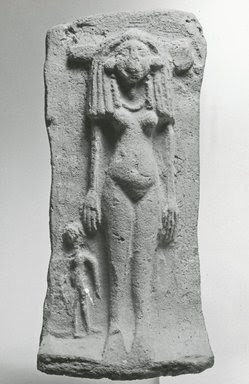
Woman and Child on a Bed


Woman and Child on a Bed
Objects of this type may have served multiple purposes. They have been found in temples, tombs, and houses. Perhaps they satisfied the sexual needs of men in the afterlife or conveyed wishes for fertility on the part of both men and women. They may have had a connection with Hathor, goddess of love and sexuality. The child here suggests the ideas of fertility and rebirth, which were vital to resurrection and immortality in the next life.
MEDIUM Clay, pigment
Place Excavated: Sawama, Egypt
DATES ca. 1539-1295 B.C.E.
DYNASTY Dynasty 18
PERIOD New Kingdom (probably)
DIMENSIONS 2 1/4 x 2 3/4 x 6 7/8 in. (5.7 x 7 x 17.5 cm)


Obelisks of Hatshepsut


Obelisks of Hatshepsut: a tall obelisk stands above a field of rubble and bricks; in the foreground lies the top of another obelisk.

Dittrich, P. - This image comes from the Travelers in the Middle East Archive (TIMEA) where it is available at the following Uniform Resource Identifier: 20945. Original source: De Guerville, A. B. "New Egypt." E.P. Dutton & Company, New York, 1906. p. 204. This tag does not indicate the copyright status of the attached work. A normal copyright tag is still required. All of TIMEA's content is licensed under a CC-BY-2.5 license. Depending on their publication date, some images might be in the public domain.


Isis, in the form of a bird,

 Isis, in the form of a bird, copulates with the deceased Osiris. At either side are Horus, although he is as yet unborn, and Isis in human form


Abydos temple


Avenue of the Sphinxes and Ptolemaic Gate


Avenue of the Sphinxes and Ptolemaic Gate, Temple of Karnak. Luxor, East Bank


1825- 1903

 Collection of The Detroit Institute of Arts


A Badarian Burial


A Badarian Burial From about 4500 - 3850 BC, Stone Age (Neolithic) communities in the Badari region buried their dead in graves lined with reed mats on which bodies were placed in a crouched position and surrounded by pottery vessels, siltstone palettes and bone tools. These are objects from grave 5710 at Badaria, an undisturbed burial of a child about 10 years of age, including; A black-topped brown ware pot with diagonal rippling and burnishing was found at the southern end of the grave (AN1925.314) A bead necklace with carnelian, 29 steatite, and shell beads. The string ran from the child's neck to the wrists. (AN1925.522) A rectangular siltstone palette (AN1925.520) A spoon of hippopotamus ivory (AN1925.521)
flickr-wiki


Badarian Burial


A Badarian Burial From about 4500 - 3850 BC, Stone Age (Neolithic) communities in the Badari region buried their dead in graves lined with reed mats on which bodies were placed in a crouched position and surrounded by pottery vessels, siltstone palettes and bone tools. These are objects from grave 5710 at Badaria, an undisturbed burial of a child about 10 years of age, including; A black-topped brown ware pot with diagonal rippling and burnishing was found at the southern end of the grave (AN1925.314) A bead necklace with carnelian, 29 steatite, and shell beads. The string ran from the child's neck to the wrists. (AN1925.522) A rectangular siltstone palette (AN1925.520) A spoon of hippopotamus ivory (AN1925.521)
flickr-wiki